

AFRICA INTELLIGENCE: PRESS FREEDOM AND RESPECT FOR THE RIGHT OF REPLY
The right of reply is neither an editorial favour nor a concession granted at the publication's discretion. It is enshrined in French law, notably the Act of 29 July 1881 on Freedom of the Press and the Act of 21 June 2004 on Confidence in the Digital Economy.
Opinion piece by BARNABÉ KIKAYA BIN KARUBI, Adviser to President Joseph KABILA KABANGE.
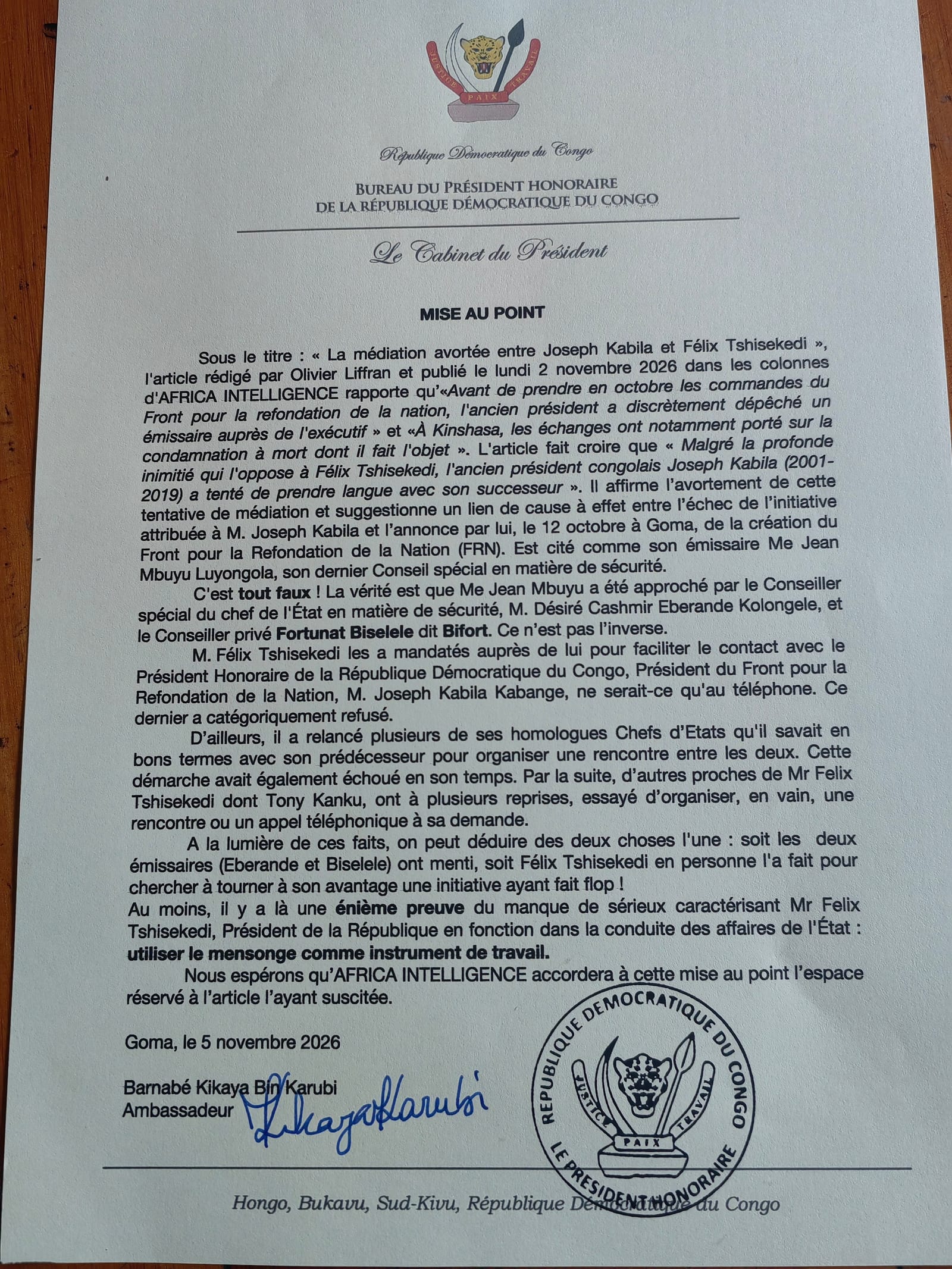
In my capacity as Adviser to Honorary President Joseph Kabila Kabange, I take note of Africa Intelligence's refusal to publish in full the statement of clarification I submitted to the publication following its article of 2 November 2026, entitled “The Failed Mediation Between Joseph Kabila and Félix Tshisekedi”.
Contrary to the claims made in that article, Honorary President Joseph Kabila did not initiate any approach to Félix Tshisekedi. On the contrary, it was the latter's envoys who unsuccessfully sought to establish contact with his predecessor.
Despite a formal request for the exercise of my right of reply, sent by registered post on 19 November 2026, Africa Intelligence has proposed replacing the original text with a shortened version rewritten by its editorial team.
“The right of reply is neither an editorial favour nor a concession granted at the publication's discretion. It is enshrined in French law, notably the Act of 29 July 1881 on Freedom of the Press and the Act of 21 June 2004 on Confidence in the Digital Economy.”
As a media professional and lecturer, I remain deeply committed to press freedom. However, press freedom is inseparable from the requirements of journalistic rigour, factual accuracy, fairness and respect for the law.
“In the interests of transparency, I am therefore making public the statement of clarification submitted to Africa Intelligence, so that everyone may judge its contents for themselves.”
Comments
Join in — no account needed.
No one has replied yet. Start the conversation.